Know your real number.
A $39 spreadsheet kit for solo handymen and small remodelers. Price any job in minutes from your own costs instead of guessing, and see afterward whether you actually made money.
- Overhead $2,870 a month
- + $60,000 pay goal
- 5 days × 9 hours × 48 weeks
- 62% of hours billable = 1,339 h
- Break-even: $70.52 an hour
- The $65 guess: below break-even
What you want to make is not what an hour costs you.
Your break-even rate is your overhead plus your pay, divided by the hours you can actually bill. Not every hour you work. Price from that and the profit you expect is the profit you get.
“I’m pulling the numbers out of my behind.”
overheard on r/handyman
- 1
A new number every time
No system, so every quote is a fresh guess and the guesses run low. Even after years in the business.
- 2
Billing hours you can’t bill
Most solo operators can only bill about 60–65% of the hours they work. Drive time, estimates and admin eat the rest. That’s a rule of thumb, not a statistic.
- 3
Markup read as margin
A 30% markup is not a 30% margin. It’s 23%. You find out after the job.
- 4
The small stuff walks off
Materials, dump fees, pickup time and small extras that never make it onto the bill.
- 5
“While you’re here”
Verbal change orders nobody wrote down. Then the awkward ask for the deposit, and chasing the final payment.
With the worked example below, charging $65 an hour is below break-even: about $7,392 a year short before any profit.
One shop, worked through to the cent.
Overhead $2,870 a month ($34,440 a year) + $60,000 pay goal, working 5 days x 9 hours x 48 weeks with 62% of hours billable = 1,339 billable hours. Break-even rate: $70.52 an hour.
- 1
Add up the year.
$2,870 a month in overhead is $34,440 a year. Truck, insurance, phone, tools, software. Add the $60,000 you want to pay yourself.
- 2
Count the hours you can bill.
5 days × 9 hours × 48 weeks, and only 62% of those hours are billable: 1,339 billable hours.
- 3
Divide.
$70.52 an hour is break-even: overhead and your pay covered, zero profit. The target rate at a 20% margin is $88.15 an hour.
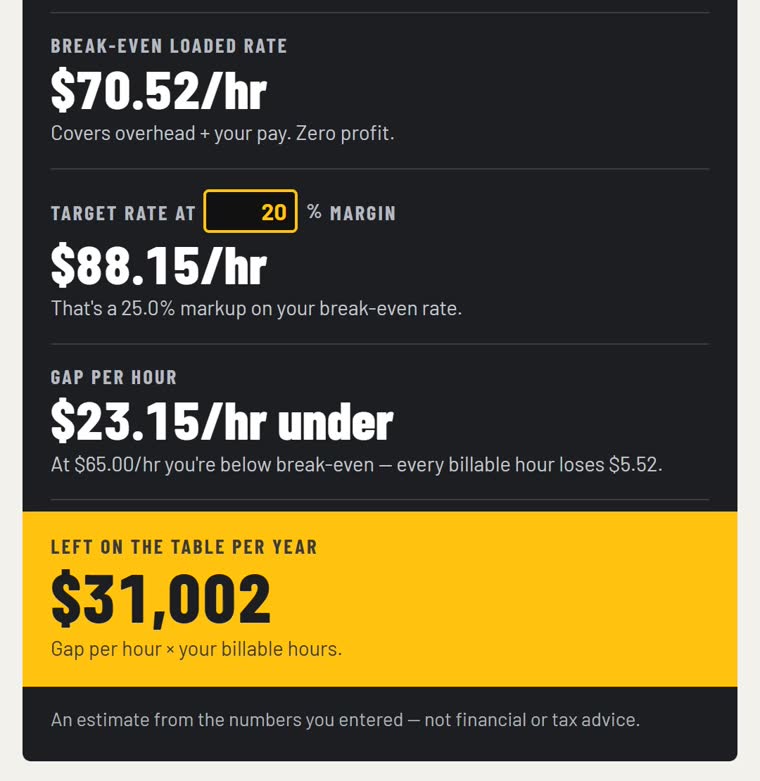
Same shop, charging $65 an hour instead of the $88.15 target: about $31,002 a year left on the table. That’s the calculator’s “left on the table” figure.
Run your own six numbersfree, no email needed
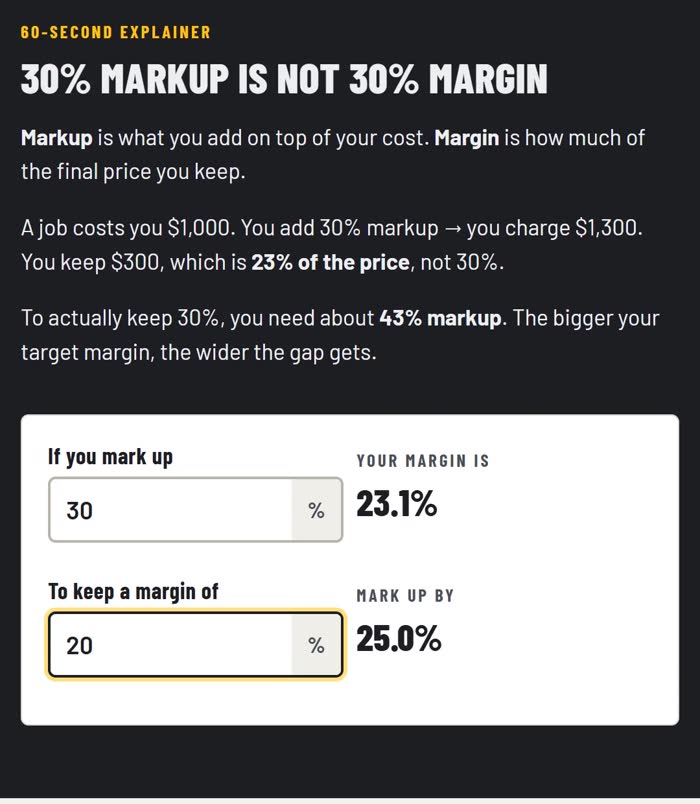
A 30% markup keeps 23%.
$1,000 of materials marked up 20% bills at $1,200. Profit is $200, which is a 16.7% margin, not 20%. To actually make a 20% margin you need a 25% markup: $1,000 cost × 1.25 = $1,250, profit $250.
| Markup | Margin |
|---|---|
| 20% | 16.7% |
| 25% | 20% |
| 30% | 23% |
| 50% | 33% |
“Just found out I made 8% on a job I thought was 25%.”
overheard on r/Contractor
Six tabs and the texts nobody likes writing.
A Google Sheets / Excel kit that works on your phone. Fill in your numbers once. Everything else prices off them.
- 1
My Numbers
Overhead + pay goal + realistic billable hours = your break-even and target rate.
- 2
Price Book
About 80 common handyman and remodel tasks with flat prices computed from your rate. Starter hours you edit.
- 3
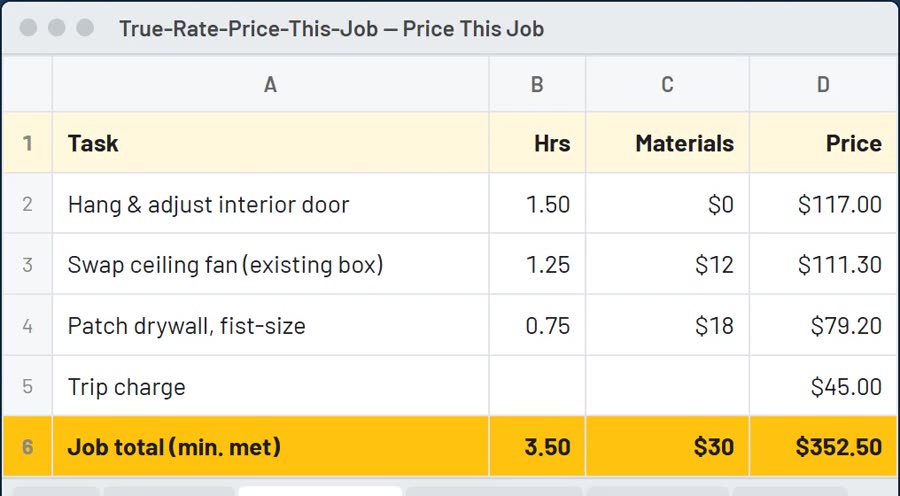
Price This Job
Pick tasks, add materials, subs, trip charge and minimum charge. See the price and the margin, with a warning if it’s too low.
- 4
Markup ↔ Margin
The converter, plus a materials and subs markup table.
- 5
Was I Right?
Estimate vs actual after every job, so you see which jobs really made money.
- 6
Client estimate
A client-ready estimate sheet.
- +
Get Paid Texts
The “while you’re here” change-order text, deposit and payment-schedule wording, final-payment reminders.
- One-time price. No subscription.
- Your data stays in your own Google Sheet.
- Built from your own costs, not national averages.
- Works on your phone in Google Sheets. No app to learn.
What it won’t do.
It’s a spreadsheet. It’s only as honest as the numbers you put in it.
- 60–65% is a rule of thumb. The billable-hours figure isn’t a statistic. Put in your own if you know it.
- The Price Book hours are starters. Edit them to how fast you actually work, or the flat prices are someone else’s.
- It’s not field-service software. It prices the job and checks it afterward. It doesn’t schedule, dispatch or take payments.
- The texts are wording, not legal advice. Contract and lien rules vary by state.
- The answers are estimates from the numbers you enter, not financial or tax advice.
- Checkout isn’t open yet. The free calculator is. The kit button goes to the True Rate site.
Pay once. Then it’s yours.
The full kit: six tabs plus Get Paid Texts, in Google Sheets or Excel. Price the job before you text the number.
Questions: contact@fantasylab.tech